I Don’t Want to Be Surprised by Cash Crunch
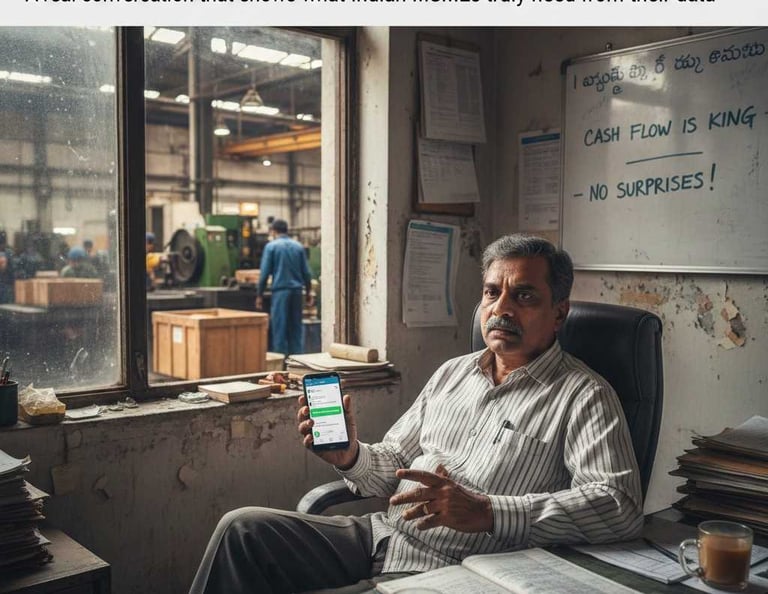
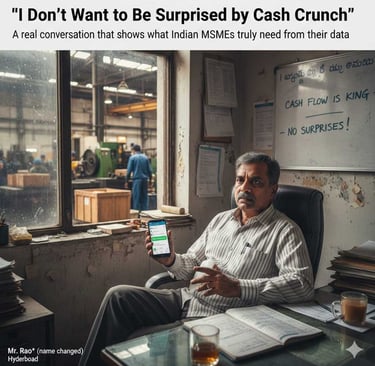
When we first met him, Mr. Rao* (name changed) didn’t talk about EBITDA, IRR, or ROCE. He leaned back in his chair, stared at his overloaded WhatsApp, and said one simple line: “I don’t want to be surprised by cash crunch."
AjaviQuantis
1/7/20263 min read
“I Don’t Want to Be Surprised by Cash Crunch”
A real conversation that shows what Indian MSMEs truly need from their data
When we first met him, Mr. Rao* (name changed) didn’t discuss EBITDA, IRR, or ROCE.
He leaned back in his chair, stared at his overloaded WhatsApp, and said one simple line:
“I don’t want to be surprised by cash crunch.”
He runs a ₹40–45 Cr manufacturing unit on the outskirts of Hyderabad.
Second-generation owner.
Good product. Loyal customers. Busy plant.
On paper, it looked like a healthy MSME.
Turnover had grown ~18% over two years
The P&L showed a reasonable profit
Bankers were familiar, vendors were mostly supportive
The factory was running at high utilisation
And yet, every few months, the same drama played out.
Vendor calls getting stuck at “Sir, payment kab tak…?”
GST, TDS, PF deadlines coming like mini heart attacks
Bank limits hovering at 90–95% utilisation
Last-minute calls to “manage” an urgent RTGS
The business was not failing.
But it was living from crunch to crunch.
Mr. Rao wasn’t asking for miracles.
He wasn’t asking for a complex ERP transformation.
He was asking for no surprises.
The real problem wasn’t profit. It was visibility.
When we dug into the numbers, this is what we found – and it’s common in many Indian MSMEs:
P&L showed profit, but
Debtor days had quietly crept up from 62 to 84
Inventory had swelled, especially slow-moving and “just in case” stock
A few large customers were sitting on big outstanding amounts, always “clearing soon”
Limits had not kept pace with the way working capital was being used
In simple terms:
The business model was okay.
The way cash moved through the system was not.
There was no early warning system.
Everyone was working hard: sales, accounts, operations, even the owner.
But the owner only saw the cash crunch after it had already arrived.
What the owner actually wanted (in his words)
After a few conversations, we translated Mr. Rao’s “No surprises” into concrete needs:
He didn’t want another detailed Excel dump.
He didn’t want a 50-page consulting report.
He wanted 3 things:
A simple view of cash inflow vs. outflow for the next 4–8 weeks
A clear picture of collections reality (who is actually paying, who is consistently slipping)
A way to see stock that can be converted into cash – slow-moving, dead, excess
In his words:
“Agar cash crunch aane wala hai, mujhe pehle pata hona chahiye.
I don’t want to wake up one morning and start calling everyone.”
That’s not a “finance problem”.
That’s a visibility and decision problem.
Turning Tally + Excel into a “Cash Early Warning System”
We didn’t suggest a big ERP or a 6-month BI project.
We started with what was already there:
Tally data
A few existing Excel reports
Bank statements
Basic inventory records
From that, we built a simple, founder-friendly cockpit.
1️⃣ Short-term cashflow view
A rolling 4–8 week cash view that showed:
Expected inflows from top 50 customers (based on ageing + patterns, not just promises)
Fixed outflows: salaries, EMIs, GST, PF, rents, utilities
Variable outflows: vendor payments, logistics, critical capex
This wasn’t a perfect forecast.
It was a practical, “good enough” radar.
2️⃣ Debtor reality dashboard
Instead of one long ageing report, we created a banker-ready, CXO-ready view:
Top overdue customers by amount and days
OEM and large-customer exposure vs. credit terms
Trend of debtor days, month-on-month
Suddenly, collections meetings became focused:
“These 15 customers are 70% of our outstanding.
What exactly is happening with each?”
3️⃣ Inventory-to-cash lens
We tagged inventory into:
Healthy stock – moving regularly
Slow-moving – not moved for 60–120 days
Dead / obsolete – no movement beyond that
That led to practical actions:
Discounted bulk sales for genuinely dead stock
Production planning aligned to existing stock
Purchase quantities right-sized to actual movement
What changed for the owner
Did this remove all cash issues forever? Of course not.
Business will always have tight months and easier months.
But within a few cycles, this is what Mr. Rao experienced:
Cash crunch stopped being a shock
He could see 4–8 weeks ahead where pressure would build
Bank meetings changed from “limit badha do” to
“Here is our debtor plan, inventory clean-up, and cashflow outlook.”Vendor discussions were done with data, not just emotion
Most importantly, his anxiety went down.
He still worked hard.
But he was no longer flying blind.
What this means for other MSME owners
If you are a founder or CXO of an MSME manufacturing business, you may recognise this pattern:
Sales are okay. P&L shows profit.
Yet cash is always tight.
You feel you’re constantly reacting, never ahead of the curve.
The first step is not a new ERP.
The first step is profit and cash clarity from the data you already have.
At AjAviQuantis Consulting, we specialise in exactly this:
Turning Tally/ERP + Excel into a profit & cashflow cockpit
Building practical dashboards for working capital, debtors and inventory
Helping founders move from surprise cash crunches to planned decisions
If Mr. Rao’s story feels like your story, we should talk.
👉 You can reach out for a confidential conversation
or
👉 Start with a simple Profit & Cash Health Check for your business.
AjAviQuantis Consulting
Turning MSME data into profit decisions — not just dashboards.
*Name and some details changed to respect client confidentiality.
email: consulting@ajaviquantis.com