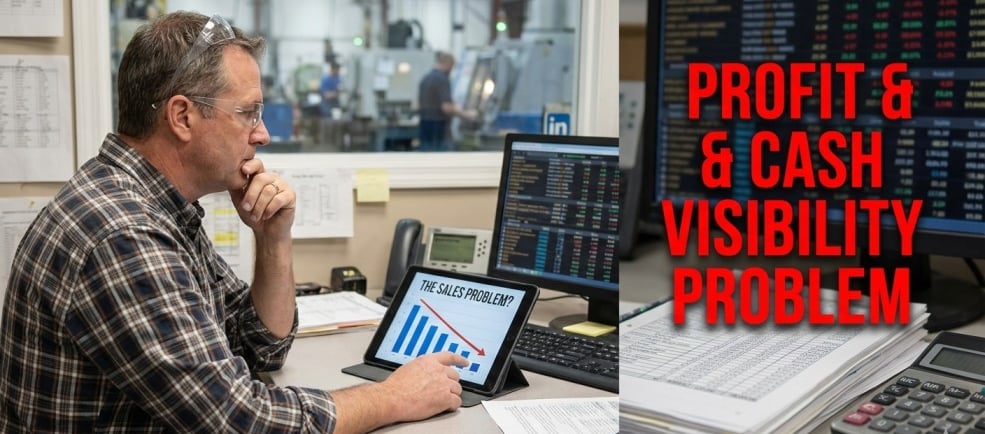
Most MSME Manufacturers Think They Have a Sales Problem.
In reality, most have a profit & cash visibility problem.
Sales are up. The plant is busy. The P&L even shows a profit. And yet, every quarter, the same pressure returns:
Limits are almost fully used
Vendors asking for payments
GST, EMIs, and salaries circling like deadlines
CXOs pulled into daily firefighting instead of thinking ahead
If this sounds like your world, this article is for you.
The uncomfortable truth: your P&L is lying by omission
Let’s start with a hard question:
As of this month, can you clearly answer: Which products, customers and plants are truly funding your salaries, EMIs and growth – and which are silently destroying value?
Most MSME leaders cannot.
They have:
Detailed P&L and trial balance
Item-wise sales and purchase reports
Excel sheets from different departments
Sometimes even a basic ERP
But they do not have a clear, monthly view of:
SKU-wise & customer-wise profit (not just sales)
Working capital reality (debtors, inventory, creditors) as one story
Capacity vs. profit (which machines/lines generate the most contribution per hour)
The result is a dangerous illusion:
“Numbers dekh liye… kuch toh profit aa hi raha hai.”
Meanwhile, underneath the headline numbers:
High-volume SKUs with low margins are eating capacity
Discounts, schemes, freight and credit terms are not fully accounted in pricing
₹30–60 lakhs is stuck in slow-moving and obsolete inventory
3–5 “star customers” are stretching credit and using your balance sheet as their bank
The emotional cost of flying partially blind
On paper, the business is “okay”. In reality, the human experience looks like this:
Founders and CXOs constantly toggling between hope and anxiety
“Good months” on turnover, but no real relief in cash
Team exhausted by urgent orders, last-minute changes, and OT
Bank meetings that feel defensive: “limit badha do” instead of “here’s our plan”
The cost of inaction is not just lower margins. It is:
Taking on debt you didn’t really need
Delaying the right capex and investing in the wrong one
Burning out good people who spend their time firefighting instead of improving
Losing negotiating power with banks, vendors, OEMs – because your story is not backed by sharp, believable numbers
If you recognise this pattern, you don’t need more isolated reports. You need a profit & cashflow cockpit.
What we do: AjAviQuantis Consulting as a strategic shift, not another “tool”
At AjAviQuantis Consulting, we help Indian MSME manufacturers (₹10–100 Cr) move from:
“We have data and reports…”
to:
“Every month, we know exactly where profit is made, where it leaks, and how our decisions will hit cash.”
We’re not here to sell you another BI tool or ERP. We are here to create a strategic shift in how your leadership team uses data.
From:
Gut feel + scattered reports + hindsight
To:
A focused, monthly profit & cash view that drives boardroom decisions
In plain words, we:
Take your existing data (Tally / basic ERP / Excel)
Stitch it into SKU-wise, customer-wise and plant-wise profit maps
Build simple dashboards (profit cockpit, working capital cockpit, capacity cockpit) that founders and CXOs can read in 10–15 minutes
Work with you to translate that clarity into pricing, mix, credit and capacity decisions
Our core belief:
You don’t need perfect systems. You need profit clarity from the systems you already have.
How it works: the AjAviQuantis Profit Clarity Method
Here’s the “magic behind the curtain” – transparent and step-by-step.
We typically work in 4 stages with MSME manufacturers.
Step 1: Ground Reality & Decision Mapping
We begin not with data, but with decisions.
We sit with your leadership team and ask:
What are the 5–7 big decisions you struggle with every quarter?
Where do you feel blind or dependent on gut?
What are your biggest cash, margin and stress points today?
Outcome of Step 1:
A shortlist of critical decisions we must support
A clear understanding of what the CEO/CFO actually wants to see each month (not 50 metrics, but the right 10–15)
We treat this as a boardroom conversation, not an IT exercise.
Step 2: Data Stitching & Profit Map
In Step 2, we roll up our sleeves with your actual data.
Typical inputs:
Tally / ERP exports (sales, purchases, GL, inventory, debtors, creditors)
Production reports, OT logs, rework/rejection data (even if partial)
Excel sheets maintained by accounts, stores, planning, sales
We then:
Clean and align
Approximate true unit economics
Create the first profit map
Outcome of Step 2:
For the first time, leadership sees a data-backed picture of:
Step 3: Cockpit Design – Profit, Cash & Capacity on One Screen Each
Now we design the dashboards that matter – not for show, but for decisions.
We usually create 3 core cockpits:
1️⃣ Profit Cockpit
Answers questions like:
Top 10 profitable SKUs and customers vs bottom 10
Monthly trend of overall and mix-adjusted margins
Which SKUs/customers are destroying value after full cost?
2️⃣ Working Capital & Cash Cockpit
Answers questions like:
Debtor days, by customer category
Top overdue customers with clear exposure
Inventory split into healthy, slow-moving, and dead stock
Simple 4–8 week cashflow outlook
3️⃣ Capacity & Operations Cockpit
Answers questions like:
Where is the true bottleneck?
What is the throughput vs achievable on critical machines/lines?
Where did rework, OT, and urgent orders hit capacity and cost?
We build these using tools that fit your reality:
Excel / Google Sheets / simple visual layers over your data
In formats that your team can maintain, not just admire once and forget
Outcome of Step 3:
The CEO/CFO can get a reliable monthly view in 10–15 minutes
The management review shifts from “what happened?” to “what should we change?”
Step 4: 90-Day Decision & Implementation Rhythm
Dashboards alone do nothing without new decisions.
In this stage, we help you use the cockpit to change behaviour.
Typical themes in the first 90 days:
Pricing & discount discipline
Customer and product focus
Working capital clean-up
Capacity rationalisation
Outcome of Step 4:
The cockpit becomes a monthly ritual, not a one-time project
Leaders start to feel in control of profit and cash, not just spectators of the P&L
What results look like: the “after” state
When profit clarity starts guiding decisions, the “after” state looks like this:
1. Financial outcomes
While each client is different, typical improvements we aim for over 6–18 months are:
2–4 percentage point improvement in contribution margin
10–20 day reduction in debtor days (frees up significant working capital)
Reduction in slow-moving/dead inventory by 20–40%
More disciplined discounting and pricing, visible on the bottom line
Even modest improvements on a ₹30–70 Cr business can mean:
₹50 lakhs to ₹2–3 Cr additional annual profit
Tens of lakhs freed from shelves and overdue debtors
2. Relationship with banks & stakeholders
With clear debtor and working capital dashboards, bank conversations shift:
From:
“Sales are good, please increase the limit, ageing thoda high hai, but manage ho jayega.”
To:
“Here is our ageing by segment, here’s the trend, here’s our action plan, and mix improvement. This is how additional working capital will translate into profit and cash, not just turnover.”
You become a credible, data-backed borrower or partner, not “just another MSME asking for limit enhancement”.
3. Leadership bandwidth & peace of mind
Perhaps the biggest shift is intangible but very real:
CXOs spend less time firefighting, more time on forward-looking decisions
Internal reviews become sharper and shorter – one cockpit, clear trade-offs
The team understands why certain customers/SKUs/practices are changing
The owner stops living in fear of surprise cash crunches
This is not about perfection. It is about moving from fog to clear visibility and deliberate control.
If you remember one idea from this article, make it this
Your biggest constraint is rarely “lack of data” or “no ERP”. Your biggest constraint is a lack of profit & cash clarity that leadership can trust every month.
Once that clarity comes:
Better pricing is a natural consequence
Better working capital is a natural consequence
Better bank relationships and growth decisions are natural consequences
Dashboards are not the goal. Decisions and results are the goal. Dashboards are just the cockpit that lets you fly the business, not just react to turbulence.
If you’re a founder, CEO, CFO or COO of an MSME manufacturing business in India and this resonates, save this article and share it with your team.
Then ask one simple question in your next review:
“Do we really know – with data – who and what is driving our profit and cash… and who is quietly taking it away?”
If the honest answer is “not clearly”, you already know where the real work begins.
AjAviQuantis Consulting – Turning MSME data into profit decisions - not just dashboards.
Contact Us


Reach out to book your profit discovery call with ajaviquantis consulting.